
Variables
Description
What is this formula?
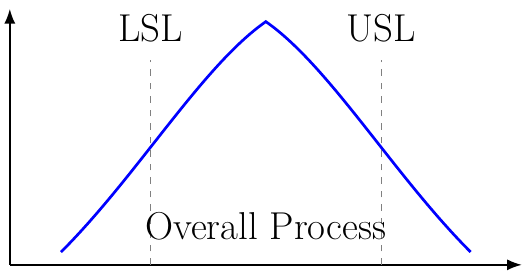
The Process Performance Index (Pp) measures the overall performance of a process by comparing specification limits with the actual long-term variation observed in production.
Unlike Cp, which uses within-subgroup variation, Pp uses the overall process variation and therefore reflects actual long-term performance.
When to use it
Use this formula when:
- Evaluating long-term process performance.
- Assessing manufacturing quality.
- Comparing actual versus potential capability.
- Supporting Six Sigma initiatives.
- Monitoring process improvement programs.
Example
A production process has:
USL = 50.5 mm
LSL = 49.5 mm
s = 0.15 mm
Formula:
Pp = (USL − LSL)/(6s)
Substitution:
Pp = (50.5 − 49.5)/(6×0.15)
Pp = 1/0.90
Pp = 1.11
Result:
The process performance index is 1.11.
Applications
- Statistical Process Control
- Six Sigma
- Manufacturing quality
- Process auditing
- Industrial quality engineering
Note
Pp differs from Cp because it uses the overall process standard deviation rather than the short-term within-subgroup variation. As a result, Pp often produces lower values and better reflects actual long-term process performance.