
Variables
Description
What is this formula?
Little's Law is one of the most important relationships in queueing theory and operations analysis.
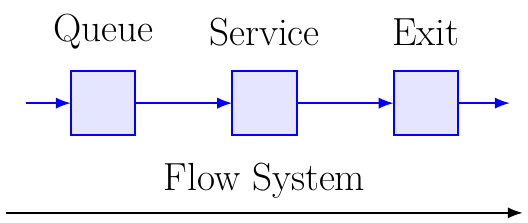
It states that the average number of items in a system equals the average arrival rate multiplied by the average time spent in the system.
When to use it
Use this formula when:
- Analyzing queues.
- Evaluating production flow.
- Studying service systems.
- Measuring work-in-process inventory.
- Improving operational efficiency.
Example
A service center receives:
λ = 20 customers/hour
Customers spend:
W = 0.5 hours
Formula:
L = λW
Substitution:
L = 20 × 0.5
L = 10
Result:
An average of 10 customers are present in the system.
Applications
- Queueing theory
- Manufacturing systems
- Lean production
- Call centers
- Hospital operations
- Supply chain analysis
Note
Little's Law is remarkably general and applies to many stable systems regardless of the arrival process or service-time distribution. The primary requirement is that the system operates in a long-term steady state.