
Variables
Description
What is this formula?
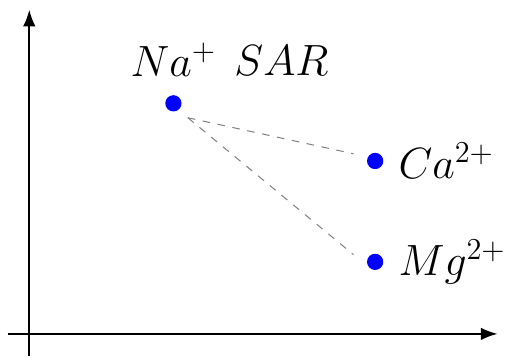
The Sodium Adsorption Ratio (SAR) evaluates the relative abundance of sodium compared with calcium and magnesium in water. It is widely used to assess irrigation water suitability and potential soil sodicity hazards.
When to use it
Use it when evaluating groundwater, surface water, reclaimed water, or agricultural irrigation water.
Example
Data:
Na = 8 meq/L
Ca = 4 meq/L
Mg = 2 meq/L
Formula:
SAR = Na / √((Ca + Mg)/2)
Substitution:
SAR = 8 / √((4 + 2)/2)
SAR = 8 / √3
Result:
SAR = 4.62
Applications
Irrigation water quality assessment, agricultural engineering, soil management, groundwater studies, environmental monitoring, and water reuse projects.
Note
SAR is an empirical water quality indicator used to estimate the potential for sodium accumulation in soils. High SAR values may reduce soil permeability and negatively affect crop growth. Various guidelines classify irrigation water based on SAR ranges and salinity levels.