
Variables
Description
What is this formula?
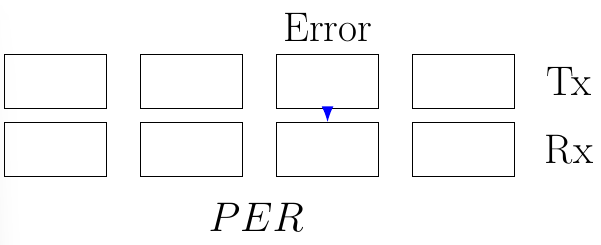
The Packet Error Rate (PER) measures the fraction of transmitted packets that contain one or more errors and therefore fail reception, validation, or decoding.
PER is widely used in data communications because packet integrity is often more important than individual bit errors.
When to use it
Use this formula when evaluating:
- Ethernet networks
- Wi-Fi systems
- Wireless sensor networks
- Satellite communications
- IoT devices
- Data transmission systems
Example
A wireless network transmits:
Nt = 50,000 packets
and receives:
Np = 175 corrupted packets
Formula:
PER = Np/Nt
Substitution:
PER = 175/50,000
PER = 0.0035
Result:
PER = 0.35%
Applications
- Network performance analysis
- Wireless communications
- Data link reliability
- Protocol evaluation
- Communication system testing
- IoT performance monitoring
Note
PER depends on packet size, channel conditions, modulation scheme, interference levels, and error-correction techniques. Larger packets generally experience higher packet error rates because a single bit error may invalidate the entire packet.