
Variables
Description
What is this formula?
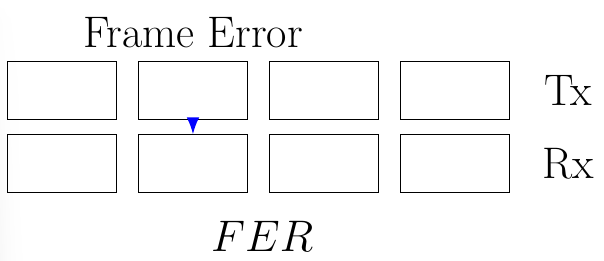
The Frame Error Rate (FER) measures the fraction of transmitted frames that are received with one or more errors.
FER is widely used in telecommunications, wireless systems, and data-link protocols where information is organized into frames rather than packets.
A frame is considered erroneous if any part of it fails integrity verification or decoding.
When to use it
Use this formula when evaluating:
- Cellular networks
- Wireless communications
- Data-link protocols
- Radio communication systems
- Digital broadcasting
- Error-control coding performance
Example
A communication system transmits:
Nt = 200,000 frames
and detects:
Nf = 420 erroneous frames
Formula:
FER = Nf/Nt
Substitution:
FER = 420/200,000
FER = 0.0021
Result:
FER = 0.21%
Applications
- Telecommunications
- Wireless networks
- Radio systems
- Protocol performance analysis
- Error-correction evaluation
- Communication reliability studies
Note
FER is related to BER and PER but represents a different level of communication performance. The relationship between BER and FER depends on frame length, coding techniques, interleaving, and error-correction methods. Longer frames generally increase the probability of frame errors.