
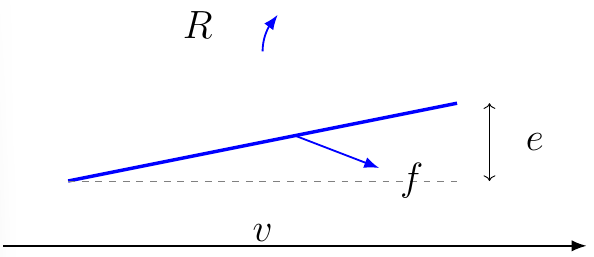
Variables
Description
What is this formula?
The Superelevation with Side Friction equation calculates the relationship between roadway banking and tire-pavement friction required to safely negotiate a horizontal curve.
Unlike the ideal equilibrium superelevation equation, this formulation recognizes that both roadway cross slope and tire friction contribute to resisting lateral acceleration.
When to use it
Use this formula when designing:
- Highways
- Expressways
- Rural roads
- Urban arterials
- Horizontal curves
Example
A roadway curve has:
v = 25 m/s
R = 300 m
f = 0.12
Formula:
e = (v²/(gR)) - f
Substitution:
e = (25²/(9.81×300)) - 0.12
e = 0.212 - 0.12
e = 0.092
Result:
e = 9.2%
Applications
- Highway geometric design
- Road safety
- Horizontal curve design
- Transportation engineering
Note
This equation is widely used in highway design standards. The side friction factor is not constant and depends on speed, pavement condition, vehicle characteristics, climate, and design criteria. Most highway agencies specify maximum allowable values for both superelevation and side friction.