
Variables
Description
What is this formula?
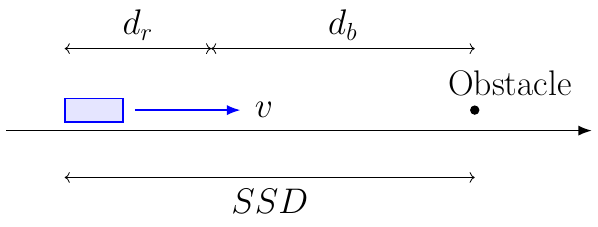
The Stopping Sight Distance (SSD) equation calculates the minimum distance required for a driver to perceive a hazard, react, and bring a vehicle to a complete stop safely.
It is one of the most fundamental formulas in highway geometric design and road safety engineering.
The stopping distance consists of two components:
Reaction distance = v·tr
Braking distance = v²/(2a)
When to use it
Use this formula when designing:
- Highways
- Urban roads
- Rural roads
- Intersections
- Crest vertical curves
- Road safety studies
Example
A vehicle travels at:
v = 27.8 m/s (100 km/h)
tr = 2.5 s
a = 3.4 m/s²
Formula:
SSD = vt_r + v²/(2a)
Substitution:
SSD = (27.8×2.5) + (27.8²/(2×3.4))
SSD = 69.5 + 113.6
SSD = 183.1 m
Result:
SSD ≈ 183 m
Applications
- Highway design
- Road safety analysis
- Intersection design
- Vertical alignment design
- Transportation engineering
Note
This equation is a simplified engineering model. Highway design standards such as AASHTO and other national guidelines may prescribe specific perception-reaction times, friction values, grades, and safety factors. On steep grades, additional correction terms are commonly applied.