
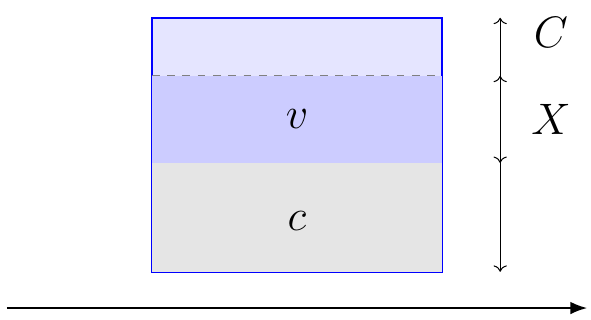
Variables
Description
What is this formula?
The Degree of Saturation is one of the most important performance indicators in transportation engineering.
It measures how much of the available roadway or intersection capacity is being utilized by traffic demand.
A higher degree of saturation indicates increasing congestion and reduced operational efficiency.
When to use it
Use this formula when evaluating:
- Signalized intersections
- Unsignalized intersections
- Urban roadways
- Highway facilities
- Traffic impact studies
Typical interpretation:
X < 0.70 → Stable operation
0.70 ≤ X < 0.90 → Near capacity
0.90 ≤ X ≤ 1.00 → Congested operation
X > 1.00 → Oversaturated condition
Example
An intersection has:
v = 1350 veh/h
C = 1800 veh/h
Formula:
X = v/C
Substitution:
X = 1350/1800
X = 0.75
Result:
X = 0.75
The facility is operating below capacity but approaching moderate congestion.
Applications
- Capacity analysis
- Level of Service studies
- Traffic signal design
- Intersection evaluation
- Transportation planning
- Traffic impact assessments
Note
The degree of saturation is a performance indicator rather than a physical law. Capacity values may come from Highway Capacity Manual procedures, local standards, simulation models, or field measurements. Different agencies may use slightly different thresholds for operational classification.