
Variables
Description
What is this formula?
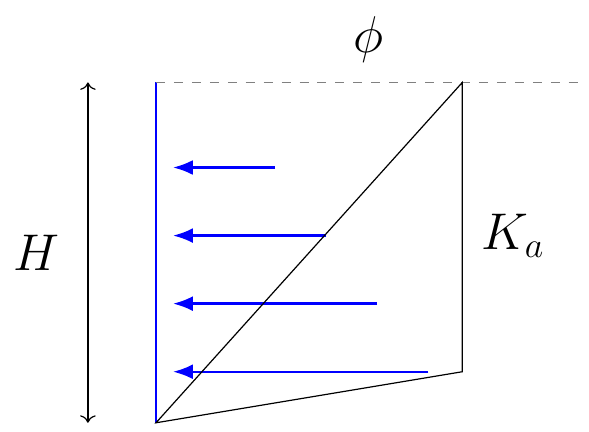
The Rankine Active Earth Pressure equation calculates the active earth pressure coefficient for a cohesionless soil.
It is one of the most widely used formulas in geotechnical engineering for retaining wall design and lateral earth pressure calculations.
The coefficient represents the minimum lateral earth pressure that develops when a retaining structure moves sufficiently away from the soil mass.
When to use it
Use this formula when analyzing:
- Retaining walls
- Basement walls
- Sheet pile walls
- Bridge abutments
- Earth-retaining structures
The equation assumes:
- Homogeneous soil
- Horizontal backfill surface
- No wall friction
- Cohesionless soil
Example
A sandy soil has:
φ = 30°
Formula:
Ka = (1-sinφ)/(1+sinφ)
Substitution:
Ka = (1-sin30°)/(1+sin30°)
Ka = (1-0.5)/(1+0.5)
Ka = 0.333
Result:
Ka ≈ 0.33
Applications
- Retaining wall design
- Earth pressure calculations
- Foundation engineering
- Excavation support systems
- Geotechnical analysis
Note
This formula is based on Rankine's earth pressure theory and represents an idealized condition. Real retaining walls may experience different earth pressures due to wall friction, sloping backfill, layered soils, groundwater, surcharges, and construction effects. Coulomb theory and modern numerical methods are often used for more complex situations.