
Variables
Description
What is this formula?
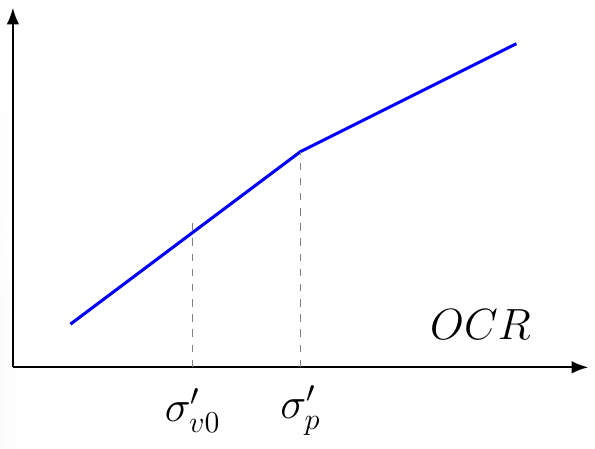
The Overconsolidation Ratio (OCR) measures the stress history of a soil by comparing its maximum past effective stress to its current effective vertical stress.
It is one of the most important parameters in geotechnical engineering because it helps classify soils as normally consolidated or overconsolidated.
When to use it
Use this formula when analyzing:
- Settlement behavior
- Consolidation problems
- Foundation design
- Embankments
- Excavations
- Soft clay deposits
Interpretation:
OCR = 1 → Normally consolidated soil
OCR > 1 → Overconsolidated soil
OCR < 1 → Usually indicates measurement or interpretation errors
Example
A clay deposit has:
σ'p = 300 kPa
σ'v0 = 120 kPa
Formula:
OCR = σ'p / σ'v0
Substitution:
OCR = 300 / 120
OCR = 2.5
Result:
OCR = 2.5
The soil is overconsolidated.
Applications
- Settlement prediction
- Consolidation analysis
- Foundation engineering
- Embankment design
- Geotechnical investigations
- Soil classification
Note
OCR is derived from laboratory and field investigations and depends on the determination of preconsolidation stress. Several methods exist for estimating σ'p, including Casagrande's method and modern numerical approaches. Small differences in σ'p estimation can significantly affect OCR values.