
Variables
Description
What is this formula?
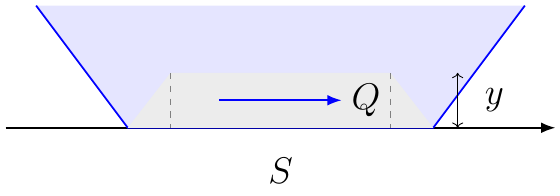
The Manning Equation estimates the flow rate in open channels based on channel geometry, hydraulic radius, slope, and surface roughness.
It is one of the most widely used equations in hydraulic engineering for rivers, canals, drainage systems, stormwater channels, and irrigation networks.
When to use it
Use this formula when analyzing:
- Open channel flow
- Irrigation canals
- Drainage channels
- Stormwater systems
- Natural streams and rivers
Example
A concrete channel has:
A = 2.5 m²
R = 0.60 m
S = 0.0016
n = 0.015
Formula:
Q = (1/n)AR^(2/3)S^(1/2)
Substitution:
Q = (1/0.015)(2.5)(0.60^(2/3))(0.0016^(1/2))
Q = 5.83 m³/s
Result:
Q ≈ 5.83 m³/s
Applications
- Irrigation engineering
- Stormwater design
- River hydraulics
- Culvert design
- Channel sizing
- Flood analysis
Note
The Manning equation is an empirical relationship developed from experimental observations. The roughness coefficient n depends on channel material, vegetation, sediment, and maintenance conditions. Different references may recommend slightly different values for n.