
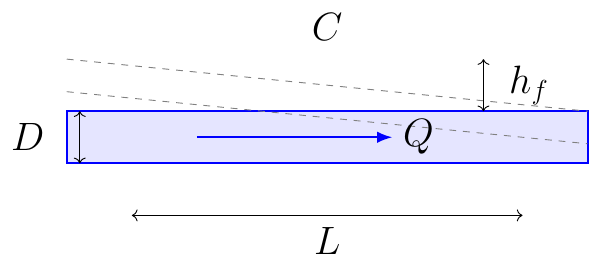
Variables
Description
What is this formula?
The Hazen–Williams Flow Rate equation estimates the flow rate of water flowing through a pressurized pipe based on pipe diameter, friction head loss, pipe length, and the Hazen–Williams roughness coefficient.
It is one of the most widely used empirical equations for water distribution systems because of its simplicity and practical accuracy within its intended range.
When to use it
Use this formula when analyzing:
- Municipal water systems
- Irrigation pipelines
- Fire protection networks
- Water distribution mains
- Civil hydraulic projects
Example
A water pipeline has:
C = 130
D = 0.30 m
hf = 4.0 m
L = 500 m
Formula:
Q = 0.278·C·D^2.63·(hf/L)^0.54
Substitution:
Q = 0.278×130×0.30^2.63×(4/500)^0.54
Q = 0.102 m³/s
Result:
Q ≈ 0.102 m³/s
Q ≈ 102 L/s
Applications
- Water supply systems
- Irrigation engineering
- Fire sprinkler networks
- Hydraulic design
- Pipeline sizing
- Distribution network analysis
Note
The Hazen–Williams equation is an empirical correlation developed specifically for water flow. It is most accurate for turbulent flow of water at ordinary temperatures and is not generally recommended for fluids other than water. The coefficient C varies with pipe material, age, and internal condition. Different standards may recommend slightly different values of C.