
Variables
Description
What is this formula?
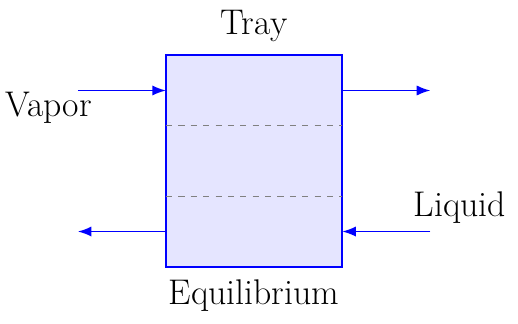
Stage efficiency measures how closely a real separation stage approaches the performance of an ideal equilibrium stage. It is widely used in distillation, absorption, stripping, and extraction processes.
When to use it
Use this formula when converting theoretical stages into actual trays, evaluating column performance, or estimating the efficiency of mass-transfer equipment.
Example
A distillation tray produces an actual vapor composition change of 0.18. Under ideal equilibrium conditions, the composition change would be 0.24.
Formula:
E = Δyactual / Δyequilibrium
Substitution:
E = 0.18 / 0.24
Result:
E = 0.75
The tray operates at 75% efficiency.
Applications
- Distillation column design
- Tray efficiency evaluation
- Absorption columns
- Stripping operations
- Process simulation
Note
Stage efficiency is an empirical parameter that depends on tray design, vapor and liquid flow rates, physical properties, and operating conditions. Several definitions exist, including Murphree efficiency, overall efficiency, and point efficiency. Murphree efficiency is the most commonly used in industrial distillation design.