
Variables
Description
What is this formula?
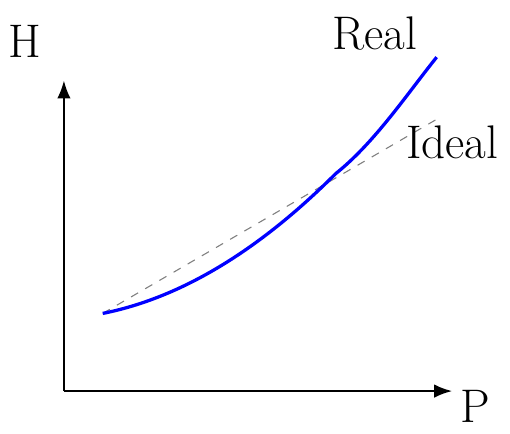
Residual enthalpy is the difference between the enthalpy of a real fluid and the enthalpy that the same substance would have if it behaved as an ideal gas at the same temperature.
When to use it
Use this equation when evaluating thermodynamic properties of real gases, performing equation-of-state calculations, or correcting ideal-gas energy balances for non-ideal behavior.
Example
A gas has a real enthalpy of 12,500 J/mol. The corresponding ideal-gas enthalpy at the same temperature is 11,900 J/mol.
Formula:
HR = H - Hig
Substitution:
HR = 12500 - 11900
Result:
HR = 600 J/mol
The non-ideal behavior contributes an additional 600 J/mol of enthalpy.
Applications
- Equation-of-state calculations
- Natural gas processing
- High-pressure thermodynamics
- Chemical process simulation
- Energy balance corrections
Note
Residual enthalpy is not a directly measurable property. It is typically calculated from equations of state such as Peng-Robinson, Soave-Redlich-Kwong, or virial models. The value approaches zero as the gas approaches ideal-gas behavior.