
Variables
Description
What is this formula?
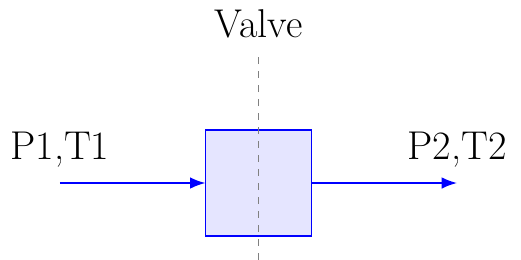
The Joule-Thomson coefficient quantifies the temperature change of a real gas caused by a pressure change during a throttling process occurring at constant enthalpy.
When to use it
Use this equation when analyzing gas expansion through valves, pressure regulators, throttling devices, refrigeration systems, and natural gas processing facilities.
Example
A natural gas stream experiences a pressure reduction of 2.0 MPa and cools by 8 K during throttling.
Formula:
μJT = ΔT / ΔP
Substitution:
μJT = 8 / (2.0×10^6)
Result:
μJT = 4.0×10^-6 K/Pa
The gas cools by approximately 4 K for every MPa of pressure reduction.
Applications
- Natural gas processing
- Cryogenic systems
- Refrigeration cycles
- Pressure reduction stations
- Thermodynamic property analysis
Note
This expression represents the finite-difference approximation of the Joule-Thomson coefficient. The rigorous thermodynamic definition is μJT=(∂T/∂P)H, evaluated at constant enthalpy. The coefficient depends strongly on gas composition, pressure, and temperature, and may be positive or negative depending on operating conditions.