
Variables
Description
What is this formula?
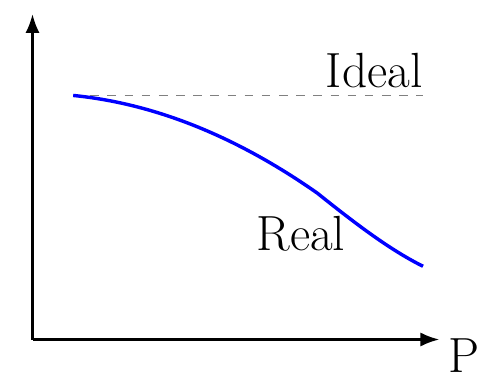
The fugacity coefficient measures the deviation of a real gas from ideal-gas behavior. It relates the fugacity of a gas to its actual pressure and is widely used in chemical thermodynamics and phase-equilibrium calculations.
When to use it
Use this equation when working with high-pressure gases, vapor-liquid equilibrium calculations, equations of state, and thermodynamic property estimation.
Example
A gas has a fugacity of 4.2 MPa at an operating pressure of 5.0 MPa.
Formula:
φ = f / P
Substitution:
φ = 4.2 / 5.0
Result:
φ = 0.84
The gas exhibits non-ideal behavior, with its fugacity being lower than its actual pressure.
Applications
- Vapor-liquid equilibrium calculations
- Natural gas processing
- Petrochemical simulations
- Equation-of-state modeling
- High-pressure thermodynamics
Note
This equation is an exact thermodynamic definition. In practical applications, the fugacity coefficient is usually calculated from equations of state such as Peng-Robinson, Soave-Redlich-Kwong, or virial equations. For an ideal gas, φ = 1.