
Variables
Description
What is this formula?
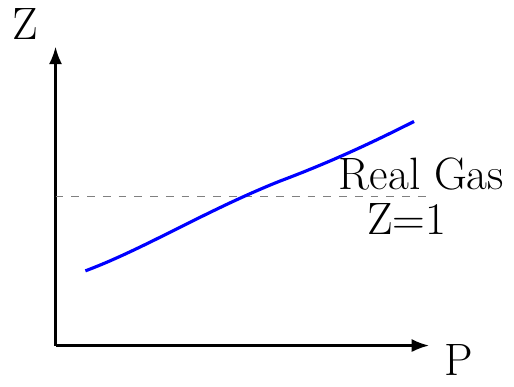
The compressibility factor quantifies the deviation of a real gas from ideal gas behavior. A value of Z=1 indicates ideal gas behavior, while values different from 1 indicate intermolecular forces and molecular volume effects.
When to use it
Use this formula when analyzing gases at elevated pressures, low temperatures, or conditions where ideal gas assumptions are no longer sufficiently accurate.
Example
A gas occupies 0.050 m³ at a pressure of 5.0×10^6 Pa and a temperature of 350 K. The amount of gas is 80 mol.
Formula:
Z = PV/(nRT)
Substitution:
Z = (5.0×10^6 × 0.050)/(80 × 8.314 × 350)
Z = 250000/232792
Result:
Z = 1.07
The gas behaves nearly ideally but exhibits a slight deviation from ideal-gas behavior.
Applications
- Natural gas processing
- Petroleum engineering
- High-pressure gas storage
- Chemical process simulation
- Equation-of-state calculations
Note
This equation is an exact thermodynamic definition of the compressibility factor. However, Z itself is usually obtained experimentally or from equations of state such as Van der Waals, Redlich-Kwong, Soave-Redlich-Kwong, or Peng-Robinson. The value of Z varies with pressure, temperature, and gas composition.