
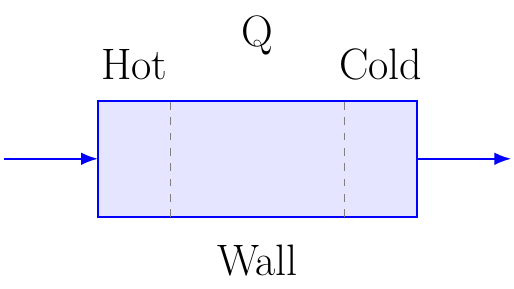
Variables
Description
What is this formula?
The overall heat transfer coefficient quantifies the combined ability of a heat exchanger to transfer heat through convection, conduction, fouling layers, and wall resistance.
When to use it
Use this formula when designing heat exchangers, evaluating thermal performance, estimating heat-transfer area requirements, or analyzing process equipment.
Example
A shell-and-tube heat exchanger transfers 1.2 MW of heat through an area of 75 m². The log mean temperature difference is 40 K.
Formula:
U = Q / (A·LMTD)
Substitution:
U = 1,200,000 / (75 × 40)
U = 1,200,000 / 3000
Result:
U = 400 W/(m²·K)
The overall heat transfer coefficient is 400 W/(m²·K).
Applications
- Shell-and-tube heat exchangers
- Plate heat exchangers
- Condensers
- Evaporators
- Process thermal design
Note
This equation provides an effective overall coefficient that incorporates all thermal resistances between the hot and cold fluids. The value of U depends on fluid properties, flow regime, fouling, exchanger geometry, and wall material.