
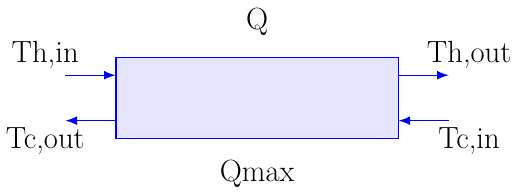
Variables
Description
What is this formula?
Heat exchanger effectiveness measures how closely a heat exchanger approaches the maximum theoretically possible heat transfer between two fluid streams.
When to use it
Use this formula when evaluating heat exchanger performance, comparing different exchanger designs, or applying the effectiveness-NTU method.
Example
A heat exchanger transfers 450 kW of heat. Under the same inlet conditions, the maximum possible heat transfer is 600 kW.
Formula:
ε = Q / Qmax
Substitution:
ε = 450 / 600
Result:
ε = 0.75
The exchanger achieves 75% of the maximum possible heat transfer.
Applications
- Heat exchanger performance evaluation
- Effectiveness-NTU method
- Process design
- Energy optimization
- HVAC systems
Note
Effectiveness is always between 0 and 1. The value depends on exchanger geometry, flow arrangement, heat capacity rates of the fluids, and the number of transfer units (NTU). Counterflow exchangers generally achieve higher effectiveness than parallel-flow exchangers.