
Variables
Description
What is this formula?
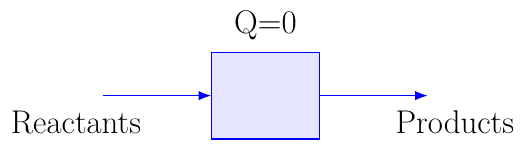
The adiabatic flame temperature estimates the maximum temperature reached by combustion products when a fuel burns without heat losses to the surroundings.
When to use it
Use this equation for preliminary combustion calculations, burner design, furnace studies, and chemical engineering energy balances when an average specific heat can be assumed.
Example
Methane combustion releases 5.0×10^7 J. The combustion products have a total mass of 20 kg, an average specific heat of 1200 J/(kg·K), and enter at 298 K.
Formula:
Tad=T0+(-ΔHr)/(mCp)
Substitution:
Tad=298+(5.0×10^7)/(20×1200)
Tad=298+2083.3
Result:
Tad≈2381 K
The estimated adiabatic flame temperature is approximately 2381 K.
Applications
- Combustion engineering
- Furnace design
- Boiler analysis
- Gas turbine studies
- Chemical reactor energy balances
Note
This equation is an approximation that assumes constant average specific heat. Real combustion calculations usually account for temperature-dependent heat capacities, chemical dissociation, and equilibrium effects, which generally reduce the actual adiabatic flame temperature.