
Variables
Description
What is this formula?
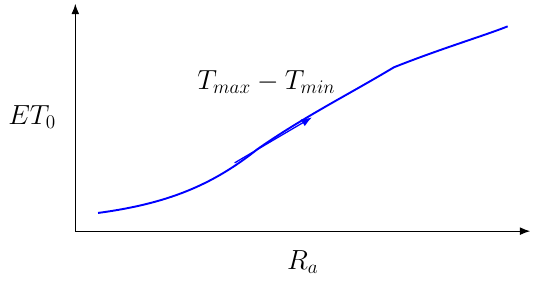
The Hargreaves equation estimates reference evapotranspiration (ET0) using air temperature and extraterrestrial solar radiation. It is one of the most widely used methods when complete meteorological data are not available.
When to use it
Use this equation when estimating crop water requirements in agricultural regions where humidity, wind speed, and solar radiation measurements are unavailable or limited.
Example
Given:
Tmean = 22 °C
Tmax = 30 °C
Tmin = 14 °C
Ra = 35 MJ/m²/day
Formula:
ET0 = 0.0023 × (Tmean + 17.8) × √(Tmax − Tmin) × Ra
Substitution:
ET0 = 0.0023 × (22 + 17.8) × √(30 − 14) × 35
ET0 = 0.0023 × 39.8 × 4 × 35
ET0 = 12.82 mm/day
Result:
The estimated reference evapotranspiration is 12.82 mm/day.
Applications
- Irrigation scheduling
- Crop water requirement estimation
- Agricultural water management
- Hydrological studies
- Preliminary irrigation design
- Drought assessment
Note
The Hargreaves equation is an empirical model developed from climatic observations. It is not a physical law.
The coefficient 0.0023 was obtained through calibration and may not provide the same accuracy in all climates.
This method is particularly useful when only temperature data are available, but it generally provides lower accuracy than the FAO-56 Penman-Monteith equation.
The extraterrestrial radiation Ra is not measured at ground level. It depends on latitude, day of the year, and astronomical relationships, and is often obtained from published tables or calculated separately.
Different regional calibrations of the Hargreaves equation exist in the literature. For high-precision irrigation design, local calibration or the FAO-56 Penman-Monteith method is usually preferred.