
Variables
Description
What is this formula?
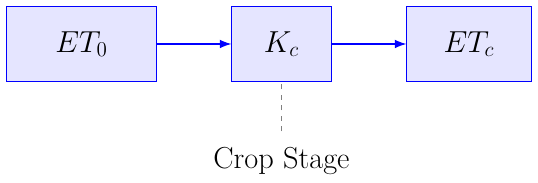
The Crop Coefficient Method estimates crop water use by first calculating reference evapotranspiration and then applying a crop-specific coefficient.
This approach is recommended by FAO and is the most widely used methodology for agricultural irrigation planning.
When to use it
Use this method when determining irrigation requirements for specific crops and growth stages.
Example
Given:
Tmean = 24 °C
Tmax = 32 °C
Tmin = 16 °C
Ra = 36 MJ/m²/day
Kc = 1.10
Step 1:
ET0 = 0.0023 × (24 + 17.8) × √(32 − 16) × 36
ET0 = 13.84 mm/day
Step 2:
ETc = 1.10 × 13.84
ETc = 15.22 mm/day
Result:
The estimated crop evapotranspiration is 15.22 mm/day.
Applications
- Irrigation scheduling
- Crop water requirement estimation
- Agricultural water management
- Irrigation project design
- Water resource planning
Note
This formula represents a calculation procedure rather than a fundamental physical law.
The FAO methodology normally computes ET0 using the Penman-Monteith equation. In this implementation, the Hargreaves equation is used because it requires fewer meteorological inputs and is more suitable for general-purpose calculators.
The coefficient Kc varies throughout the crop life cycle and should be selected according to the crop growth stage.
Using locally calibrated Kc values generally improves irrigation accuracy.