
Variables
Description
What is this formula?
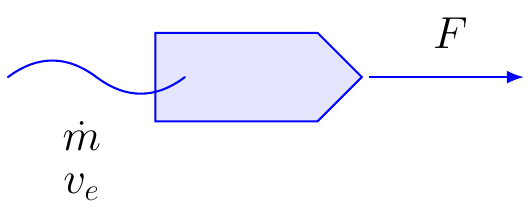
The Thrust Equation calculates the thrust generated by a rocket or jet propulsion system from the propellant mass flow rate and effective exhaust velocity.
It represents the fundamental momentum relationship behind rocket propulsion.
When to use it
Use this equation when estimating rocket thrust, engine performance, propulsion system sizing, or propellant requirements.
It is widely used in rocket engineering, spacecraft propulsion, and aerospace design.
Example
A rocket engine has:
Mass flow rate = 250 kg/s
Effective exhaust velocity = 3000 m/s
Formula:
F = mdot × ve
Substitution:
F = 250 × 3000
F = 750000 N
Result:
Thrust = 750 kN
Applications
Rocket engine design
Spacecraft propulsion
Launch vehicle analysis
Propulsion system sizing
Engine performance evaluation
Aerospace engineering
Note
This is the ideal momentum thrust equation. Real rocket engines may also generate pressure thrust due to differences between nozzle exit pressure and ambient pressure. A more complete thrust equation includes both momentum thrust and pressure thrust terms. The present form is commonly used for preliminary design and educational calculations.