
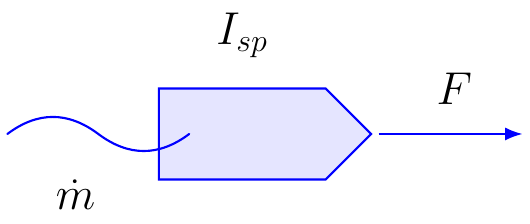
Variables
Description
What is this formula?
The Specific Impulse Relation calculates the specific impulse of a propulsion system from its thrust and propellant consumption rate.
Specific impulse is the most widely used measure of rocket engine efficiency and indicates how effectively a propulsion system converts propellant into thrust.
When to use it
Use this equation when evaluating rocket engines, comparing propulsion technologies, estimating mission performance, or analyzing propellant efficiency.
It is widely used in astronautics, spacecraft engineering, and launch vehicle design.
Example
A rocket engine produces:
Thrust = 500000 N
Propellant mass flow rate = 200 kg/s
Standard gravity = 9.80665 m/s²
Formula:
Isp = F / (mdot × g0)
Substitution:
Isp = 500000 / (200 × 9.80665)
Isp = 254.9 s
Result:
Specific impulse = 255 s
Applications
Rocket engine comparison
Spacecraft propulsion analysis
Mission performance estimation
Launch vehicle design
Propellant efficiency evaluation
Astronautics
Note
Specific impulse is not a direct measure of thrust but of propellant efficiency. Higher specific impulse indicates that a propulsion system produces more impulse per unit weight flow of propellant. Different propulsion technologies may have dramatically different specific impulse values, ranging from chemical rockets to electric propulsion systems.