
Variables
Description
What is this formula?
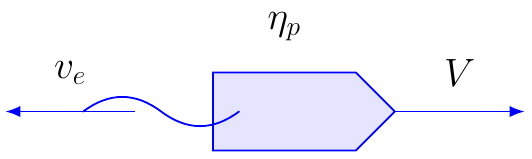
The Propulsive Efficiency equation estimates how effectively a propulsion system converts the kinetic energy of its exhaust into useful vehicle motion.
It is an important performance metric in aerospace propulsion because maximum thrust does not necessarily imply maximum efficiency.
When to use it
Use this equation when evaluating propulsion systems, comparing engines, studying aircraft performance, or analyzing rocket and jet propulsion efficiency.
It is commonly used in aerospace engineering and propulsion system design.
Example
An aircraft travels at:
Vehicle velocity = 250 m/s
Effective exhaust velocity = 500 m/s
Formula:
ηp = 2V / (V + ve)
Substitution:
ηp = (2 × 250) / (250 + 500)
ηp = 0.667
Result:
Propulsive efficiency = 66.7%
Applications
Aircraft propulsion analysis
Jet engine performance
Rocket propulsion studies
Engine comparison
Propulsion system optimization
Aerospace engineering
Note
This equation is an idealized propulsive efficiency model derived from momentum theory. It assumes steady operation and neglects losses such as mechanical inefficiencies, combustion losses, nozzle losses, and aerodynamic drag. Real propulsion systems may exhibit lower efficiencies depending on operating conditions and engine design.