
Variables
Description
What is this formula?
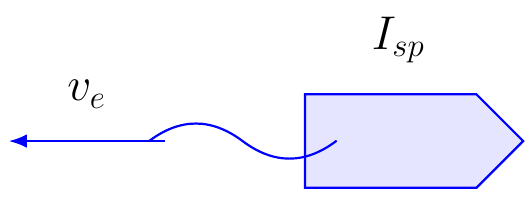
The Effective Exhaust Velocity formula converts specific impulse into an equivalent exhaust velocity.
It provides a direct measure of how fast propellant leaves a propulsion system and is widely used in rocket performance calculations.
Effective exhaust velocity is the parameter used in the Tsiolkovsky Rocket Equation.
When to use it
Use this equation when converting rocket engine specific impulse into exhaust velocity for mission analysis, delta-v calculations, and propulsion system comparisons.
It is commonly used in astronautics and spacecraft engineering.
Example
A rocket engine has:
Specific impulse = 320 s
Standard gravity = 9.80665 m/s²
Formula:
ve = Isp × g0
Substitution:
ve = 320 × 9.80665
ve = 3138.1 m/s
Result:
Effective exhaust velocity = 3138 m/s
Applications
Rocket performance analysis
Delta-v calculations
Spacecraft mission planning
Propulsion system comparison
Launch vehicle design
Astronautics
Note
Effective exhaust velocity is not necessarily equal to the actual measured gas velocity at the nozzle exit. It is an equivalent velocity that incorporates all thrust-producing effects and provides a convenient parameter for rocket performance calculations. The relation assumes the standard definition of specific impulse using standard Earth gravity.