
Variables
Description
What is this formula?
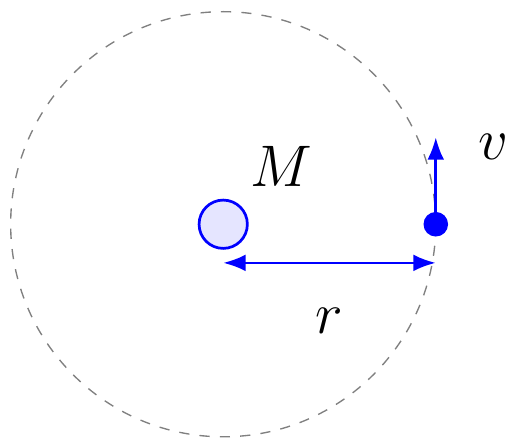
The Orbital Period equation calculates the time required for a satellite or spacecraft to complete one full circular orbit around a central body.
It is derived from Newtonian gravitation and circular orbital motion and is one of the fundamental equations of astrodynamics.
When to use it
Use this equation when determining the orbital period of satellites around planets, moons around planets, or spacecraft in circular or nearly circular orbits.
It is commonly used in mission planning, satellite operations, and aerospace engineering.
Example
A satellite orbits Earth at:
Orbital radius = 7.0×10^6 m
Earth gravitational parameter = 3.986×10^14 m³/s²
Formula:
T = 2π√(r³/μ)
Substitution:
T = 2π√((7.0×10^6)³/(3.986×10^14))
T = 5828 s
Result:
Orbital period = 5828 s
Orbital period = 97.1 min
Applications
Satellite mission design
Spacecraft trajectory analysis
Orbital mechanics education
Ground station scheduling
Earth observation satellites
Space mission planning