
Variables
Description
What is this formula?
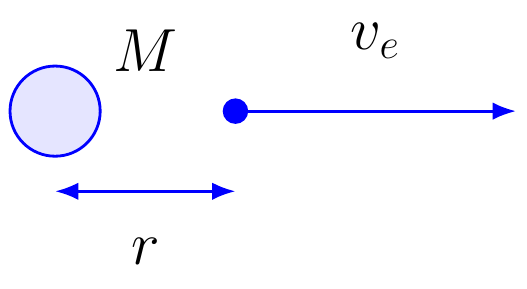
The Escape Velocity formula calculates the minimum speed required for an object to escape the gravitational attraction of a celestial body without further propulsion.
It is one of the fundamental equations of orbital mechanics and space mission analysis.
When to use it
Use this formula when determining the velocity required for a spacecraft, probe, or particle to leave the gravitational field of a planet, moon, asteroid, or star.
It is widely used in launch vehicle design, planetary science, and astrodynamics.
Example
A spacecraft is launched from Earth at:
Distance from Earth's center = 6.371×10^6 m
Earth gravitational parameter = 3.986×10^14 m³/s²
Formula:
ve = √(2μ/r)
Substitution:
ve = √((2×3.986×10^14)/(6.371×10^6))
ve = 11186 m/s
Result:
Escape velocity = 11.19 km/s
Applications
Space mission design
Launch vehicle analysis
Planetary exploration
Astrodynamics
Gravitational studies
Orbital mechanics education