
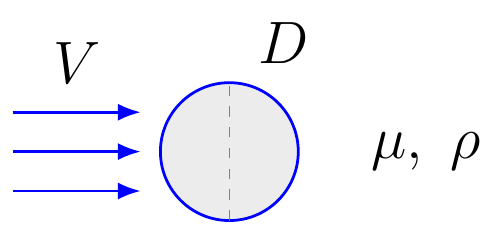
Variables
Description
What is this formula?
The Reynolds Number is a dimensionless quantity that compares inertial forces to viscous forces within a fluid flow.
It is one of the most important parameters in fluid mechanics because it helps determine whether a flow is laminar, transitional, or turbulent.
When to use it
Use this formula when analyzing fluid flow around aircraft, wings, pipes, turbines, vehicles, or any engineering system involving moving fluids.
It is widely used in aerodynamics, hydrodynamics, heat transfer, and CFD simulations.
Example
Air flows over an airfoil with:
Density = 1.225 kg/m³
Velocity = 50 m/s
Characteristic length = 1.5 m
Dynamic viscosity = 1.81×10^-5 Pa·s
Formula:
Re = (ρ × V × D) / μ
Substitution:
Re = (1.225 × 50 × 1.5) / (1.81×10^-5)
Re = 5.08×10^6
Result:
Reynolds number = 5.08 million
Applications
Aircraft wing analysis
Wind tunnel testing
CFD model scaling
Pipe flow calculations
Heat transfer analysis
Aerospace engineering
Note
The Reynolds number is not a physical property but a dimensionless similarity parameter. Critical Reynolds values depend on geometry, surface roughness, and flow conditions. Different engineering applications may use different characteristic lengths when calculating Reynolds number.