
Variables
Description
What is this formula?
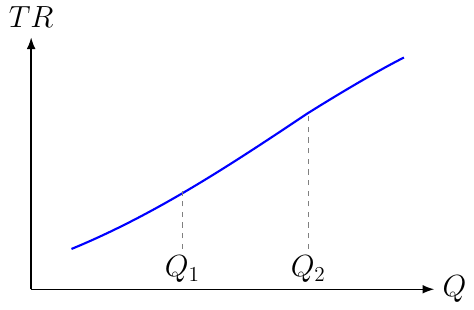
Marginal Revenue measures the additional revenue generated by selling one more unit of output.
It is a fundamental concept in microeconomics and plays a central role in profit-maximization decisions.
When to use it
Use this formula when analyzing pricing strategies, production decisions, market structure, and firm profitability.
Example
Initial sales quantity:
Q1 = 100 units
Final sales quantity:
Q2 = 120 units
Initial total revenue:
TR1 = 4,000 USD
Final total revenue:
TR2 = 4,700 USD
Formula:
MR = (TR2−TR1)/(Q2−Q1)
Substitution:
MR = (4700−4000)/(120−100)
MR = 700/20
MR = 35 USD/unit
Result:
Each additional unit sold generates approximately 35 USD of additional revenue.
Applications
- Profit maximization
- Pricing strategy
- Market analysis
- Revenue forecasting
- Business decision-making
Note
This formula calculates marginal revenue over a finite interval and therefore represents an average marginal revenue between two production levels. In economic theory, marginal revenue is often defined as the derivative of total revenue with respect to quantity, but this discrete form is more suitable for practical calculations.