
Variables
Description
What is this formula?
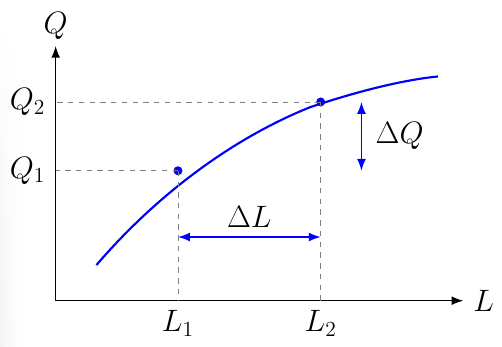
Marginal Product of Labor measures the additional output generated when labor input increases, holding other production factors constant.
It shows how much extra production is obtained from adding more labor to the production process.
When to use it
Use this formula when analyzing labor productivity, production efficiency, hiring decisions, and diminishing marginal returns.
Example
Initial labor input:
L1 = 10 workers
Final labor input:
L2 = 12 workers
Initial output:
Q1 = 500 units
Final output:
Q2 = 620 units
Formula:
MPL = (Q2−Q1)/(L2−L1)
Substitution:
MPL = (620−500)/(12−10)
MPL = 120/2
MPL = 60 units/worker
Result:
Each additional worker adds approximately 60 units of output.
Applications
- Labor productivity analysis
- Production planning
- Hiring decisions
- Cost-benefit analysis
- Microeconomic production theory
Note
This discrete formula estimates the marginal product over a finite change in labor input. In theory, marginal product is often defined as the derivative of output with respect to labor, but this version is more practical for observed production data.