
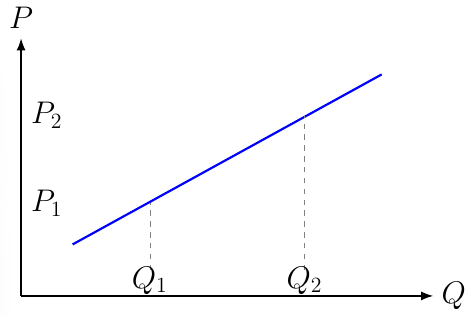
Variables
Description
What is this formula?
Price Elasticity of Supply measures how responsive the quantity supplied of a good is to changes in its price.
It quantifies the percentage change in quantity supplied resulting from a one percent change in price.
When to use it
Use this formula when evaluating producer responsiveness, market flexibility, production constraints, and the effects of price changes on supply.
Example
Initial price:
P1 = 20 USD
Final price:
P2 = 24 USD
Initial quantity supplied:
Q1 = 500 units
Final quantity supplied:
Q2 = 600 units
Formula:
Es = ((Q2−Q1)/Q1)/((P2−P1)/P1)
Substitution:
Es = ((600−500)/500)/((24−20)/20)
Es = 0.20/0.20
Es = 1.0
Result:
Supply has unit elasticity. A 1% increase in price produces approximately a 1% increase in quantity supplied.
Applications
- Production planning
- Agricultural economics
- Commodity market analysis
- Industrial economics
- Supply forecasting
Note
This formula uses percentage changes relative to the initial values. Supply elasticity often differs between the short run and the long run because producers may require time to adjust production capacity.