
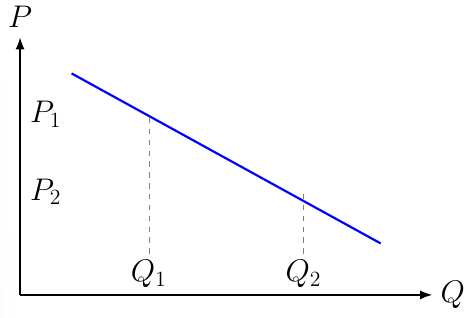
Variables
Description
What is this formula?
Price Elasticity of Demand measures how sensitive the quantity demanded of a good is to changes in its price.
It quantifies the percentage change in quantity demanded resulting from a one percent change in price.
When to use it
Use this formula when analyzing consumer behavior, pricing strategies, taxation effects, and market responsiveness.
Example
Initial price:
P1 = 10 USD
Final price:
P2 = 11 USD
Initial quantity demanded:
Q1 = 1000 units
Final quantity demanded:
Q2 = 900 units
Formula:
Ed = ((Q2−Q1)/Q1)/((P2−P1)/P1)
Substitution:
Ed = ((900−1000)/1000)/((11−10)/10)
Ed = -0.1/0.1
Ed = -1.0
Result:
Demand has unit elasticity. A 1% increase in price produces approximately a 1% decrease in quantity demanded.
Applications
- Pricing decisions
- Revenue optimization
- Tax policy analysis
- Market research
- Demand forecasting
Note
This formula uses percentage changes relative to the initial values. Alternative methods such as arc elasticity use average values and often provide more symmetric results when price changes are large.