
Variables
Description
What is this formula?
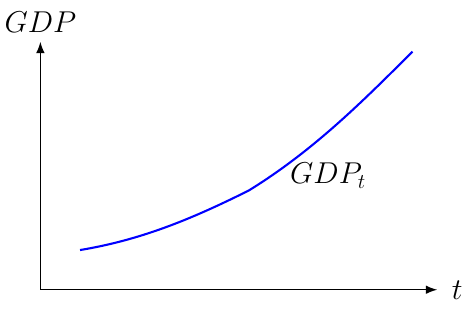
The Compound Economic Growth Rate measures the constant annual growth rate that would transform an initial GDP into a final GDP over a specified number of periods.
It is equivalent to the Compound Annual Growth Rate (CAGR) commonly used in economics and finance.
When to use it
Use this formula when GDP growth spans multiple years and annual growth rates are not constant.
It provides a standardized measure of long-term economic growth.
Example
Initial GDP:
GDPi = 1.5 trillion USD
Final GDP:
GDPf = 2.0 trillion USD
Time:
n = 8 years
Formula:
g = ((GDPf/GDPi)^(1/n)-1) × 100
Substitution:
g = ((2.0/1.5)^(1/8)-1) × 100
g = 3.66%
Result:
The economy experienced an average compound growth rate of approximately 3.66% per year.
Applications
- Long-term economic analysis
- GDP growth comparisons
- Development studies
- Economic forecasting
- International benchmarking
Note
This formula assumes a constant equivalent growth rate over the entire period. Actual GDP growth typically fluctuates from year to year. The result should therefore be interpreted as an average annualized growth rate rather than the actual growth achieved in each year.