
Variables
Description
What is this formula?
The Quantity Theory of Money expresses the relationship between the money supply, the velocity of money, the average price level, and the real output of an economy.
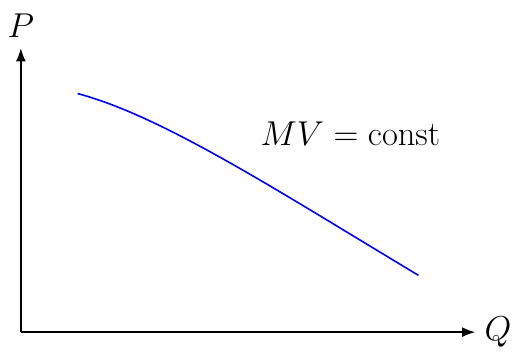
It states that the total money spent in an economy (MV) equals the nominal value of goods and services produced (PQ).
When to use it
Use this formula when analyzing inflation, monetary policy, money supply effects, and macroeconomic equilibrium.
It is commonly used in introductory and intermediate macroeconomics courses and in monetary policy discussions.
Example
Suppose:
Money supply M = 2,000 billion USD
Velocity of money V = 4
Real output Q = 5,000 billion units
Formula:
MV = PQ
Substitution:
P = (M × V) / Q
P = (2000 × 4) / 5000
P = 1.6
Result:
The implied aggregate price level is 1.6.
Applications
- Monetary policy analysis
- Inflation studies
- Central bank modeling
- Economic forecasting
- Macroeconomic education