
Variables
Description
What is this formula?
Forecast Bias measures the systematic tendency of a forecasting model to consistently overestimate or underestimate actual values.
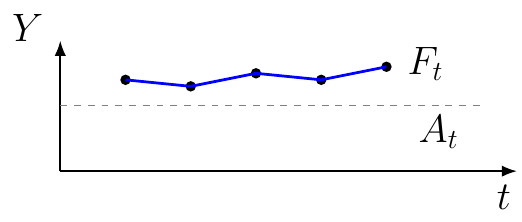
A positive bias indicates that forecasts tend to be higher than actual observations, while a negative bias indicates that forecasts tend to be lower than actual observations.
Forecast Bias is one of the most important indicators used to evaluate forecast quality and detect systematic forecasting errors.
When to use it
Use this formula when evaluating forecasting performance and determining whether a forecasting model consistently overpredicts or underpredicts observed values.
Example
Suppose:
Forecast Value = 125
Actual Value = 115
Formula:
B=F-A
Substitution:
B=125-115
B=10
Result:
Forecast Bias = 10
Interpretation:
The forecast overestimated the actual value by 10 units.
Applications
Forecast evaluation
Demand forecasting
Sales forecasting
Inventory planning
Economic forecasting
Business analytics
Operations management
Note
Forecast Bias is a performance indicator rather than a forecasting model. In practice, bias is often evaluated across many periods using the Mean Forecast Error (MFE), which averages forecast errors over a dataset. The present formula represents the forecast error for a single observation and serves as the fundamental building block of more advanced bias metrics.