
Variables
Description
What is this formula?
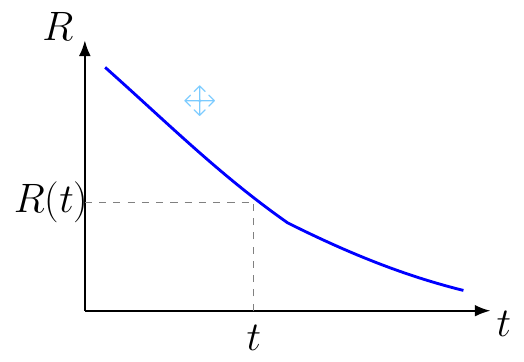
The Exponential Reliability Function calculates the probability that a component, system, or device will continue operating without failure up to a specified time.
It is one of the most widely used reliability models in engineering, economics, operations research, maintenance planning, and risk analysis.
When to use it
Use this formula when failures occur randomly at a constant average failure rate.
It is particularly useful for electronic equipment, industrial systems, infrastructure assets, and reliability studies.
Example
A component has a failure rate of:
λ = 0.002 h⁻¹
Operating time:
t = 500 h
Formula:
R=e^(-λt)
Substitution:
R=e^(-0.002×500)
R=e^(-1)
R=0.368
Result:
Reliability = 36.8%
This means the probability that the component remains operational after 500 hours is approximately 36.8%.
Applications
Reliability engineering
Maintenance planning
Risk assessment
Operations research
Asset management
Industrial engineering
Infrastructure analysis
Note
The Exponential Reliability Function is based on the assumption of a constant failure rate. This assumption is often valid during the useful life phase of many systems but may not accurately represent early-life failures or wear-out failures. More advanced reliability models such as Weibull distributions are commonly used when failure rates vary over time.