
Variables
Description
What is this formula?
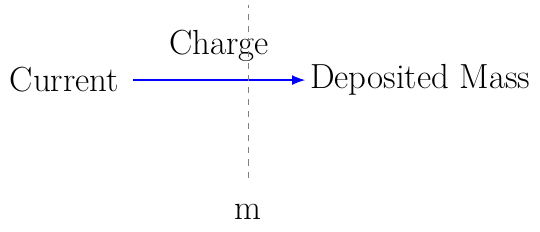
Faraday's Law of Electrolysis calculates the amount of substance produced or consumed during an electrochemical process based on the electric charge passed through the system.
It directly links electricity and chemical transformation.
When to use it
Use this formula when calculating metal deposition, electroplating thickness, electrorefining production, gas generation, or electrolysis yields.
Example
Given:
I = 5.0 A
t = 3600 s
M = 63.55 g/mol (Cu)
n = 2
F = 96485 C/mol
Formula:
m = (ItM)/(nF)
Substitution:
m = (5×3600×63.55)/(2×96485)
Result:
m ≈ 5.93 g
Approximately 5.93 grams of copper are deposited.
Applications
Electroplating
Electrorefining
Battery technology
Industrial electrolysis
Corrosion studies
Chemical engineering
Note
Faraday's Law assumes 100% current efficiency, meaning that all electrical charge contributes to the desired electrochemical reaction.
In industrial systems, side reactions, gas evolution, impurities, and transport limitations may reduce the actual yield.
The total electric charge is:
Q = I × t
and one Faraday (96485 C) corresponds to one mole of electrons transferred.