
Variables
Description
What is this formula?
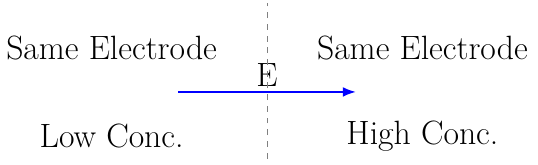
A concentration cell generates electrical potential solely because of a difference in ion concentration between two half-cells containing the same electrode material.
Unlike ordinary galvanic cells, no difference in electrode composition is required.
When to use it
Use this formula when calculating the voltage generated by concentration differences in electrochemical systems.
Example
Given:
C2 = 1.00 mol/L
C1 = 0.010 mol/L
T = 298 K
n = 2
R = 8.314 J·mol^-1·K^-1
F = 96485 C/mol
Formula:
E = (RT/nF)ln(C2/C1)
Substitution:
E = ((8.314×298)/(2×96485))ln(1.00/0.010)
Result:
E ≈ 0.059 V
The concentration difference generates a potential of approximately 59 mV.
Applications
Electrochemistry
Electrochemical sensors
Corrosion studies
Membrane systems
Battery science
Analytical chemistry
Note
This equation is a special case of the Nernst equation.
Because both electrodes are chemically identical, the standard cell potential is zero:
E° = 0
The entire cell voltage arises from the concentration gradient.
As the concentrations become equal:
C2 = C1
the logarithmic term becomes zero and the cell potential disappears.
Concentration cells provide a direct demonstration of how chemical potential differences can be converted into electrical energy.