
Variables
Description
What is this formula?
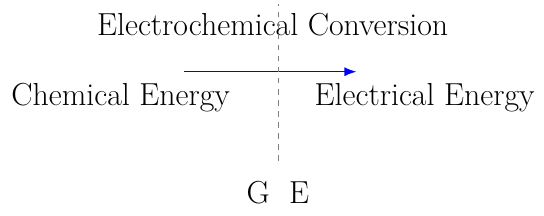
This equation relates the Gibbs free energy change of an electrochemical reaction to the electrical potential generated by the cell.
It provides the direct connection between thermodynamics and electrochemistry.
When to use it
Use this equation when determining the maximum electrical work obtainable from a chemical reaction or when converting between Gibbs energy and cell potential.
Example
Given:
n = 2
F = 96485 C/mol
E = 1.10 V
Formula:
ΔG = -nFE
Substitution:
ΔG = -(2)(96485)(1.10)
Result:
ΔG = -212267 J/mol
ΔG ≈ -212 kJ/mol
The negative Gibbs free energy indicates that the electrochemical reaction is thermodynamically spontaneous.
Applications
Electrochemistry
Battery design
Fuel cells
Corrosion analysis
Thermodynamics
Electrochemical engineering
Note
This equation represents the maximum reversible electrical work obtainable from an electrochemical reaction.
Important interpretations:
ΔG < 0 → spontaneous cell reaction
ΔG = 0 → equilibrium
ΔG > 0 → non-spontaneous reaction
The negative sign reflects the convention that a spontaneous galvanic cell produces positive electrical potential while decreasing Gibbs free energy.