
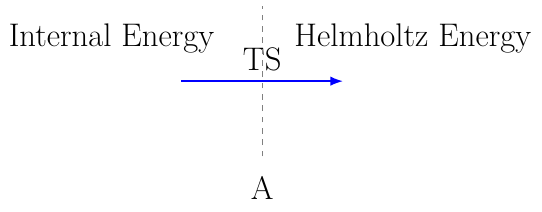
Variables
Description
What is this formula?
The Helmholtz free energy represents the maximum useful work obtainable from a thermodynamic system at constant temperature and constant volume.
It is one of the fundamental thermodynamic potentials used in physical chemistry, statistical mechanics, and materials science.
When to use it
Use this formula when analyzing systems that operate at constant temperature and constant volume, such as closed containers, theoretical thermodynamic models, and many statistical mechanics applications.
Example
Given:
U = 5000 J
T = 300 K
S = 10 J/K
Formula:
A = U − TS
Substitution:
A = 5000 − (300 × 10)
Result:
A = 2000 J
The system contains 2000 J of Helmholtz free energy available for useful work under constant-volume conditions.
Applications
Chemical thermodynamics
Statistical mechanics
Physical chemistry
Materials science
Thermodynamic modeling
Note
The Helmholtz free energy is most useful for systems maintained at constant temperature and constant volume.
Its differential form is:
dA = −S dT − P dV
which shows that A naturally depends on temperature and volume.
In chemistry, Gibbs free energy is generally used more frequently because most laboratory and industrial processes occur at approximately constant pressure. Helmholtz free energy becomes particularly important in theoretical thermodynamics, condensed matter physics, and statistical mechanics.