
Variables
Description
What is this formula?
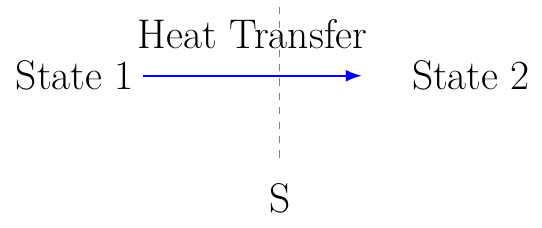
This equation calculates the entropy change associated with a reversible heat transfer process at constant temperature.
Entropy is a thermodynamic property that measures energy dispersal and the number of possible microscopic arrangements of a system.
When to use it
Use this formula for reversible isothermal processes where heat is transferred at a constant absolute temperature.
Example
Given:
q = 2500 J
T = 298 K
Formula:
ΔS = q/T
Substitution:
ΔS = 2500/298
Result:
ΔS = 8.39 J/K
The system experiences an entropy increase of 8.39 J/K.
Applications
Chemical thermodynamics
Phase transitions
Heat transfer analysis
Chemical engineering
Physical chemistry
Note
This equation is valid only for reversible heat transfer at constant temperature. For irreversible processes or processes where temperature changes significantly, entropy changes are generally calculated by integrating δqrev/T over the thermodynamic path.
Entropy is a state function, meaning that its change depends only on the initial and final states, not on the specific path taken.