
Variables
Description
What is this formula?
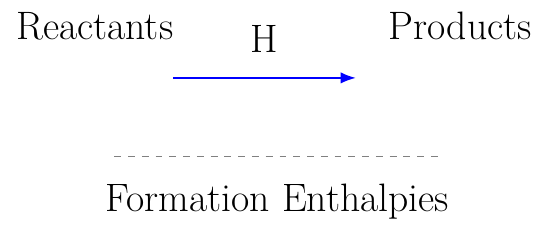
Hess's Law states that the enthalpy change of a reaction depends only on the initial and final states and is independent of the reaction pathway.
This equation calculates the reaction enthalpy from standard enthalpies of formation.
When to use it
Use this formula when determining reaction enthalpies from tabulated thermodynamic data or evaluating energy balances in chemical processes.
Example
Reaction:
CH4 + 2O2 → CO2 + 2H2O
Given:
ΔHf(CH4) = -74.8 kJ/mol
ΔHf(O2) = 0 kJ/mol
ΔHf(CO2) = -393.5 kJ/mol
ΔHf(H2O) = -285.8 kJ/mol
Formula:
ΔHrxn = Σ(products) − Σ(reactants)
Substitution:
ΔHrxn = [-393.5 + 2(-285.8)] - [-74.8 + 2(0)]
Result:
ΔHrxn = -890.3 kJ/mol
Applications
Chemical thermodynamics
Combustion analysis
Reaction engineering
Process design
Energy balances
Note
The rigorous form of Hess's Law is usually written using summation notation over all reactants and products. Because fCalc requires explicit equations, this implementation uses a fully expanded form for a typical reaction. The same thermodynamic principle applies to reactions containing any number of species.