
Variables
Description
What is this formula?
The Clausius–Clapeyron equation relates vapor pressure to temperature and allows prediction of vapor pressure changes from thermodynamic data.
It is one of the most important equations in phase equilibrium and thermodynamics.
When to use it
Use this equation to estimate vapor pressure at a new temperature, determine enthalpy of vaporization, or analyze liquid-vapor equilibrium behavior.
Example
Given:
P1 = 101.3 kPa
T1 = 373.15 K
T2 = 393.15 K
ΔHvap = 40650 J/mol
R = 8.314 J·mol^-1·K^-1
Formula:
P2 = P1·e^((-ΔHvap/R)(1/T2−1/T1))
Substitution:
P2 = 101.3 × e^((-40650/8.314)(1/393.15−1/373.15))
Result:
P2 ≈ 193 kPa
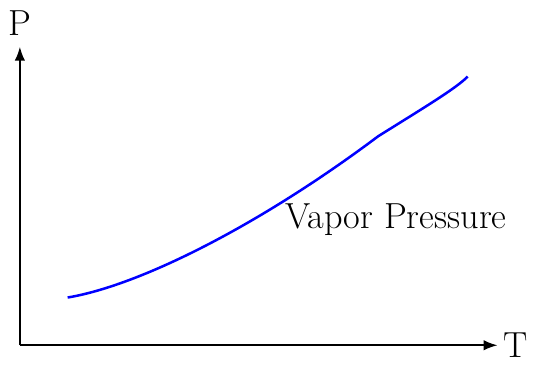
The vapor pressure increases significantly as temperature rises.
Applications
Phase equilibrium
Distillation design
Chemical engineering
Thermodynamics
Atmospheric science
Materials processing
Note
This integrated form assumes that the enthalpy of vaporization remains approximately constant over the temperature range considered and that the vapor behaves ideally.
For large temperature intervals or highly non-ideal systems, more advanced vapor-pressure correlations may provide greater accuracy.
The Clausius–Clapeyron equation is widely used for estimating boiling points, vapor pressures, and phase-transition properties.