
Variables
Description
What is this formula?
The zero-order rate law describes a reaction whose rate remains constant and does not depend on reactant concentration.
When to use it
Use this formula for reactions that exhibit zero-order kinetics, often observed in catalytic systems, surface-controlled reactions, photochemical processes, and enzyme-catalyzed reactions operating under saturation conditions.
Example
Given:
A0 = 1.00 mol/L
k = 0.020 mol·L^-1·s^-1
t = 15 s
Formula:
A = A0 - kt
Substitution:
A = 1.00 - (0.020×15)
Result:
A = 0.70 mol/L
Applications
Chemical kinetics
Catalytic reactions
Photochemistry
Enzyme kinetics
Reaction engineering
Note
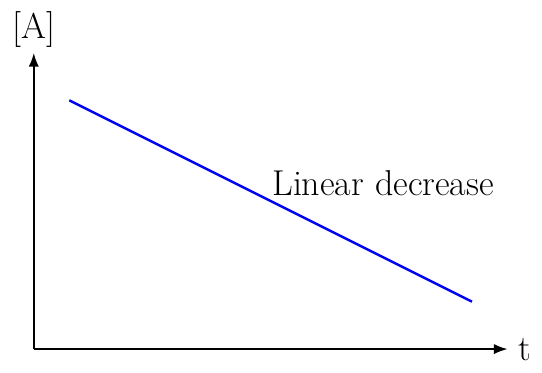
Zero-order behavior occurs when the reaction rate is limited by factors other than reactant concentration, such as catalyst surface availability, light intensity, or enzyme saturation. The concentration decreases linearly with time until the reactant is depleted. After complete depletion, the model is no longer physically meaningful.