
Variables
Description
What is this formula?
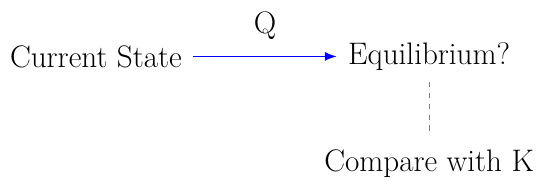
The reaction quotient is calculated using the same mathematical expression as the equilibrium constant, but it uses the current concentrations or activities of reactants and products rather than equilibrium values.
When to use it
Use this formula to determine whether a reaction system will proceed forward, backward, or is already at equilibrium.
Example
Reaction:
N2 + 3H2 ⇌ 2NH3
Given:
[N2] = 1.00 mol/L
[H2] = 0.50 mol/L
[NH3] = 0.20 mol/L
Formula:
Q = [NH3]^2 / ([N2][H2]^3)
Substitution:
Q = (0.20)^2 / (1.00×0.50^3)
Result:
Q = 0.32
If K = 20:
Q < K
The reaction will proceed toward the products until equilibrium is reached.
Applications
Chemical equilibrium prediction
Reaction engineering
Industrial chemistry
Process monitoring
Thermodynamics
Note
The reaction quotient and equilibrium constant have identical mathematical forms but different meanings. Q is calculated from the current state of the system, while K is calculated at equilibrium.
Interpretation:
Q < K → Reaction proceeds toward products
Q = K → System is at equilibrium
Q > K → Reaction proceeds toward reactants
This comparison is one of the most important tools in equilibrium analysis.