
Variables
Description
What is this formula?
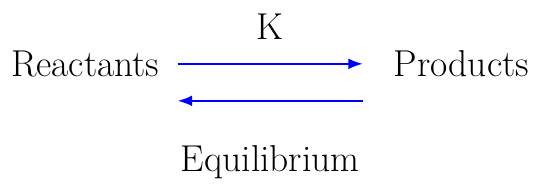
The equilibrium constant expression relates the concentrations of reactants and products at chemical equilibrium according to the balanced reaction equation.
For a general reaction:
aA + bB ⇌ cC + dD
the equilibrium constant is defined by the ratio of product activities to reactant activities raised to their stoichiometric coefficients.
When to use it
Use this formula to determine equilibrium concentrations, evaluate reaction extent, compare reaction conditions, and analyze reversible chemical systems.
Example
Reaction:
N2 + 3H2 ⇌ 2NH3
Given:
[N2] = 0.50 mol/L
[H2] = 0.40 mol/L
[NH3] = 0.80 mol/L
Formula:
K = [NH3]^2 / ([N2][H2]^3)
Substitution:
K = (0.80)^2 / (0.50×0.40^3)
Result:
K = 20.0
The equilibrium strongly favors ammonia formation.
Applications
Chemical equilibrium analysis
Reaction engineering
Industrial chemistry
Thermodynamics
Chemical process design
Note
The rigorous definition of the equilibrium constant uses activities rather than concentrations. In many practical calculations, concentrations are used as an approximation. This approximation is most accurate in dilute systems where activity coefficients are close to unity. Different forms such as Kc, Kp, and Ka are specific applications of the same equilibrium principle.