
Variables
Description
What is this formula?
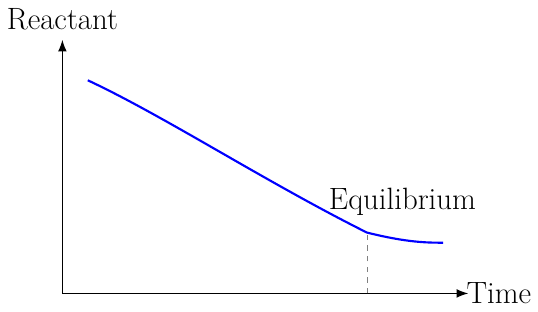
The degree of conversion at equilibrium represents the fraction of the initial reactant that has been converted into products when chemical equilibrium is reached.
When to use it
Use this formula to evaluate equilibrium-limited reactions, determine maximum achievable conversion, and analyze reversible chemical processes.
Example
Given:
Initial reactant amount = 10.0 mol
Reactant amount at equilibrium = 3.5 mol
Formula:
Xe = (n0 - ne)/n0
Substitution:
Xe = (10.0 - 3.5)/10.0
Result:
Xe = 0.65
The equilibrium conversion is 65%.
Applications
Chemical equilibrium analysis
Reaction engineering
Reactor design
Industrial chemistry
Thermodynamics
Note
Unlike ordinary conversion, which may be measured at any reaction time, equilibrium conversion specifically refers to the conversion obtained when the forward and reverse reaction rates become equal.
The equilibrium conversion depends on temperature, pressure, feed composition, and the equilibrium constant. In many industrial processes, the equilibrium conversion represents the maximum conversion achievable without changing operating conditions or removing products from the system.