
Variables
Description
What is this formula?
The SN1 reaction rate law describes a unimolecular nucleophilic substitution where the rate depends only on the concentration of the substrate, usually an alkyl halide.
When to use it
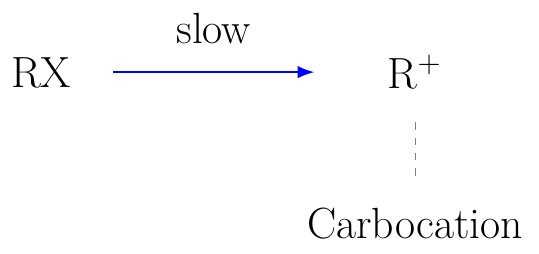
Use this formula for SN1 reactions where the slow, rate-determining step is the formation of a carbocation from the substrate.
Example
Given:
k = 0.0020 s^-1
[RX] = 0.15 mol/L
Formula:
Rate = k[RX]
Substitution:
Rate = 0.0020 × 0.15
Result:
Rate = 3.0×10^-4 mol·L^-1·s^-1
Applications
Organic reaction kinetics
Nucleophilic substitution
Mechanism analysis
Solvolysis reactions
Organic chemistry education
Note
This rate law applies to ideal SN1 behavior where carbocation formation is the rate-determining step. The nucleophile concentration does not appear in the rate law because it reacts after the slow step. Real reaction rates can be affected by solvent polarity, substrate structure, leaving group ability, temperature, and competing SN2 or elimination pathways.