
Variables
Description
What is this formula?
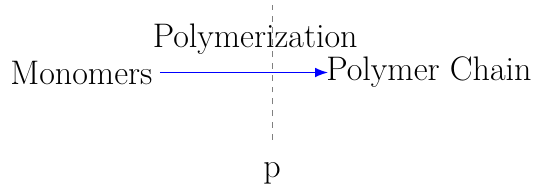
The degree of conversion in polymerization represents the fraction of reactive groups that have been consumed during the polymerization process.
When to use it
Use this formula to monitor polymerization progress, evaluate reaction completion, and estimate polymer properties that depend on monomer conversion.
Example
Given:
Initial reactive groups = 1000
Unreacted groups = 120
Formula:
p = (N0 - N)/N0
Substitution:
p = (1000 - 120)/1000
Result:
p = 0.88
The polymerization conversion is 88%.
Applications
Polymer chemistry
Reaction engineering
Resin curing
Industrial polymer production
Materials science
Note
The degree of conversion is one of the most important parameters in polymer chemistry because many polymer properties depend strongly on conversion. In step-growth polymerization, high molecular weights typically require very high conversions, often above 95% or even 99%. The symbol p is widely used in polymer science literature.